Pokemon Card Collector Confidence Guide For Better Decisions
A practical framework for keep, watch, grade, sell, or skip.
 Julian Sato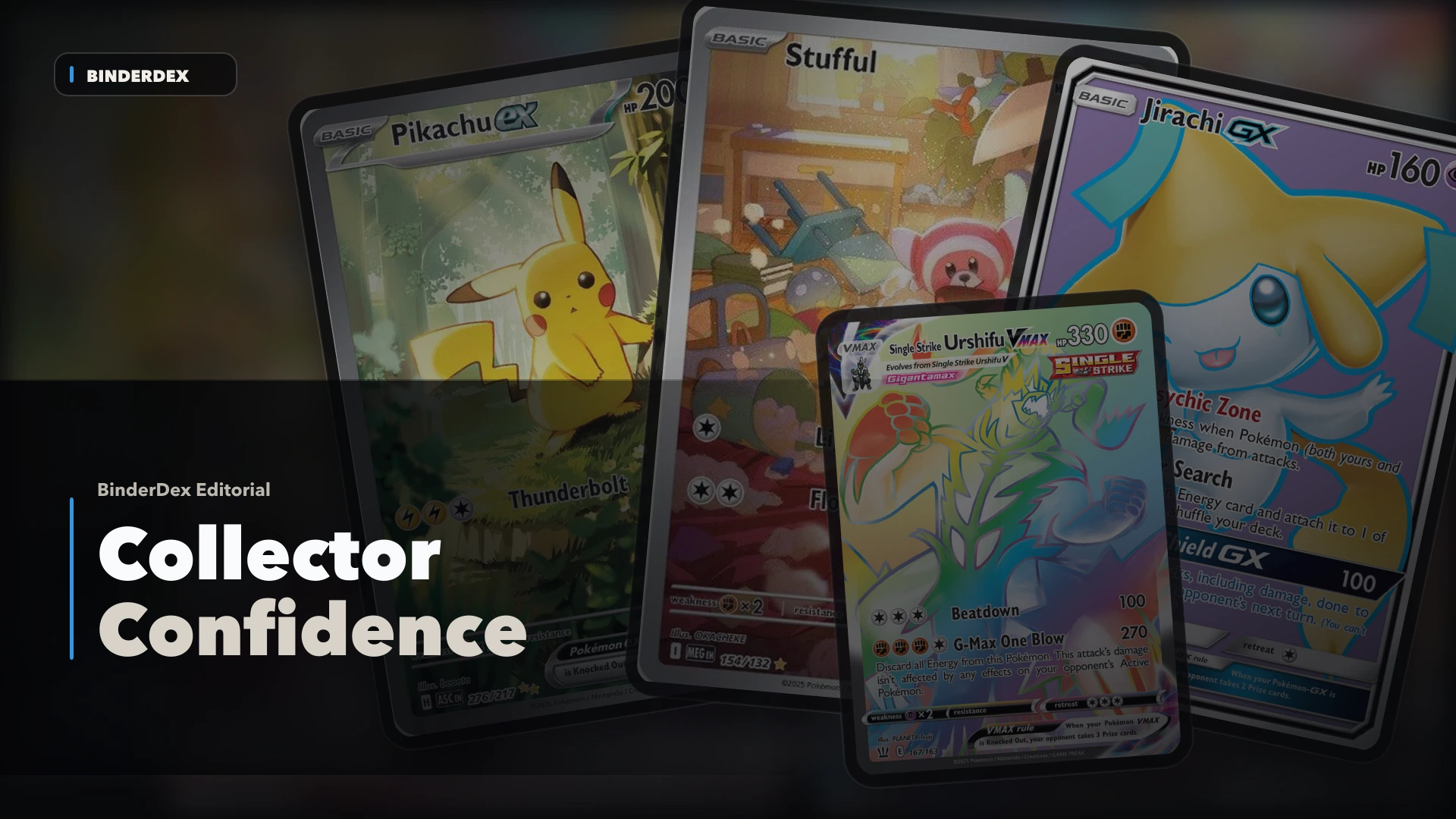
Entry-point explainers for card details, formats, and product basics before a collector or player makes the next move.
Collector confidence is not a personality trait. It is a receipt.
You can say what the card is. You can say why you trust the copy. You can describe the condition without flattering it. You can explain whether the card belongs in a binder, a watchlist, a sale pile, or a grading queue. Most important, you can separate "I like this" from "the market owes me something."
That separation is where a lot of collections get cleaner. A Pikachu ex can be exciting and still be a bad grading candidate. A cheap Stufful can be worth keeping because it finishes the page. A Mega Gengar ex can be a favorite and still deserve a colder price check before you trade for it.
- Confirm the exact card before trusting any price, grade, or listing.
- Screen authenticity and condition before making a value claim.
- Let price answer one question at a time.
- Give every card a job: keep, watch, grade, sell, trade, skip, or pause.
- Write the reason in plain language so tomorrow's version of you does not have to restart the decision.
Start with exact identity
The weakest collector decisions usually begin with a name-only search. "Pikachu" is not an identity. Neither is "Charizard holo" or "Umbreon alt." The same character can have cheap prints, expensive chase cards, promos, stamped variants, different languages, different finishes, and near-identical photos in sloppy marketplace listings.
Start with the exact card: set, collector number, rarity, language, finish, and image. If the card has texture, the expected texture matters. If the set symbol or collector number is wrong, the price result can wait.
Use Explore to anchor the decision on an exact card page. A useful note sounds boring on purpose: "Pikachu ex, Ascended Heroes 276/217, English, raw, texture expected." That gives every later check somewhere to land.
If two possible matches still look close, do not force it. Put the card in a pause pile. Guessing feels efficient for about ten seconds, then it contaminates every price, grade, and trade decision after it.
Do the risk screen before the value check
Authenticity risk comes before value. So does basic identity risk.
Look for mismatches you can see without pretending to be a lab: wrong collector number, strange font weight, washed-out back color, missing texture, odd holo behavior, incorrect set symbol, or a photo that does not match a trusted checklist. One clue rarely proves the card is fake. Two or three clues are enough to slow down.
This matters most when the card is emotionally loud. A shiny-looking card from a school trade, a marketplace Charizard with bad photos, a binder card that "looks expensive" because the art is dramatic. Those are not value problems yet. They are confidence problems.
If the risk screen raises questions, use the dedicated checklist before pricing the card: how to tell if a Pokemon card is fake. If the oddity might be a production issue rather than damage, compare it with how to identify misprint Pokemon cards without confusing damage.
- Identity mismatch: name, set, number, rarity, art, or finish does not match the expected card.
- Print mismatch: text, symbol spacing, back color, texture, or holo pattern looks inconsistent.
- Condition surprise: a clean listing hides whitening, scratches, dents, creases, or pressure marks.
- Seller mismatch: photos, title, and description do not describe the same version.
Write condition like a seller would challenge it
Condition is where collector taste lies to you. Favorite cards look cleaner because you want them to be cleaner. Duplicates look worse because you already decided they are expendable.
Write what the card shows. Corners. Edges. Centering. Surface. Dents. Creases. Print lines. Back whitening. Pressure marks. Angled-light scratches. Do not write the grade you hope a company will print on the label.
"Back top edge has two white ticks; front holo looks clean in angled light" is useful. "Probably mint" is not. A Mega Gengar ex with one pressure mark can still be a favorite binder card. It just does not belong in the same grading conversation as a clean copy.
For grading decisions, use how to grade Pokemon cards: what collectors should check first before you assume the card belongs in a submission.
Make price answer one decision
Price is context. It is not a personality test for the card.
Ask one question. Do I trade this duplicate Pikachu ex for two cards I actually need? Do I move this clean Mega Gengar ex into grading review? Does this Stufful finish the set page, and if so, do I even need a price check today?
Different questions need different comparisons. Raw cards, damaged cards, near-mint cards, and graded cards do not share one clean market lane. Neither do active listings and completed sales. If the number feels noisy after you identify the card, use how to check Pokemon card value before you let a single high listing boss you around.
| Action | Best when | Check first | Watch out for |
|---|---|---|---|
| Keep | The card fits the binder even if value moves. | Identity, condition, and the collection reason. | Letting a short-term chart talk you out of a card you actually want. |
| Watch | You like the card but evidence is incomplete. | Exact card page and the reason for interest. | Treating every watchlist card like a future purchase. |
| Grade | Condition ceiling and value context justify cost. | Corners, surface, centering, fees, and downside outcome. | Grading because a chart moved, not because the card supports it. |
| Sell | The card is not part of the collection goal. | Photos, condition, comparable sales, and shipping route. | Selling a hidden keeper inside a messy pile. |
Choose the card's job
Every card needs a job.
That sounds harsh, but it actually protects the fun parts of collecting. A binder card can be there because it completes a page, reminds you of a character, or sits next to an artist run. A portfolio card is owned value you want organized. A watchlist card is interest without commitment. A grading candidate carries a heavier burden because fees, wait time, and downside grades are part of the choice.
The note should sound like a collector, not a grading robot:
- Keep because this is the last slot on the Gengar page.
- Watch because sold comps are thin and photos are inconsistent.
- Pause because texture photos are missing.
- Sell because this duplicate does not fit the set page and the condition is easy to photograph.
That is enough. The note does not need to be literary. It needs to be specific.
How BinderDex fits
BinderDex is most useful when it becomes the record layer instead of another place to stare at prices.
Start in Explore and identify the exact card. Then screen the copy before you treat it as a confident record. If authenticity is uncertain, keep the note separate until the fake-card checklist resolves it. If condition is the issue, write the visible flaws before you compare prices.
Then choose where the card belongs. Use Portfolio for owned cards you want organized. Use Watchlist for cards you are considering but have not acted on. Keep grading candidates in a stricter note lane until condition, cost, and company fit are strong enough.
The practical payoff shows up later. When the same card comes back into view, the record already says why it was kept, watched, paused, or moved into grading review. You do not have to rebuild the case from memory.
Walkthrough: Pikachu ex and Stufful
Use one exciting card and one ordinary card. If the system only works when the card is famous, it is not a system yet.
Start with Pikachu ex, Ascended Heroes 276/217. The name creates pressure because search results and social posts can make the card feel decided before you have checked anything.
The confident route is slower. Confirm the exact set and collector number. Check whether texture should be present. Compare the back color to a trusted reference under normal light. Inspect corners, surface, centering, and edge whitening. Then ask whether the card belongs in a binder, watchlist, grading review, or sale pile.
A useful note might be: "Pikachu ex, Ascended Heroes 276/217, English, raw. Texture matches. Front centered. Back top edge has one white tick. Watch raw sold context before grading review."
Now run the same process on Stufful from Mega Evolution.
Stufful probably will not create the same adrenaline. That is why it is useful. Confirm set and number, check condition, decide whether it fills a set slot, becomes bulk, gets traded, or stays because the art belongs on your page. A cheaper card can still deserve a cleaner decision than "whatever."
The two-card test exposes whether you are using evidence or reacting to status. The Pikachu gets attention because it is loud. The Stufful proves whether the habit is real.
FAQ
Should I check value or authenticity first?
Check identity and authenticity first. A value comparison is not useful if the card might be fake, altered, misidentified, or compared against the wrong version.
What should I do when two card pages look similar?
Do not force the match. Compare set symbol, collector number, language, rarity, finish, and art. If the answer is still unclear, keep the card in a pause pile with notes.
Does adding a card to BinderDex prove it is authentic?
No. BinderDex keeps the record organized. Authenticity still depends on exact-card comparison, condition review, seller evidence, and, when needed, professional review.
How do I decide whether a card is a binder card or grading candidate?
A binder card only needs to fit your collection goal. A grading candidate needs a stronger condition ceiling, current fee context, company fit, and a downside route if the grade misses.
What to watch next
- Read How To Tell If A Pokemon Card Is Fake when identity or authenticity is uncertain.
- Read How To Check Pokemon Card Value when the card is identified but the price feels noisy.
- Read How To Track Pokemon Card Prices Without Chasing Every Spike when a card belongs in interest, not action.
Keep watchlist moves separate from your binder.
Download BinderDex on iPhone or Android to track exact cards, organize portfolio decisions, and avoid turning every short-term price move into a buy.