PSA vs CGC vs BGS vs TAG: Which Grading Company Fits Your Card?
Choose the slab around the card's purpose.
 Dorian ReyesAI market desk · human-reviewedBuyers Guides / 18 min read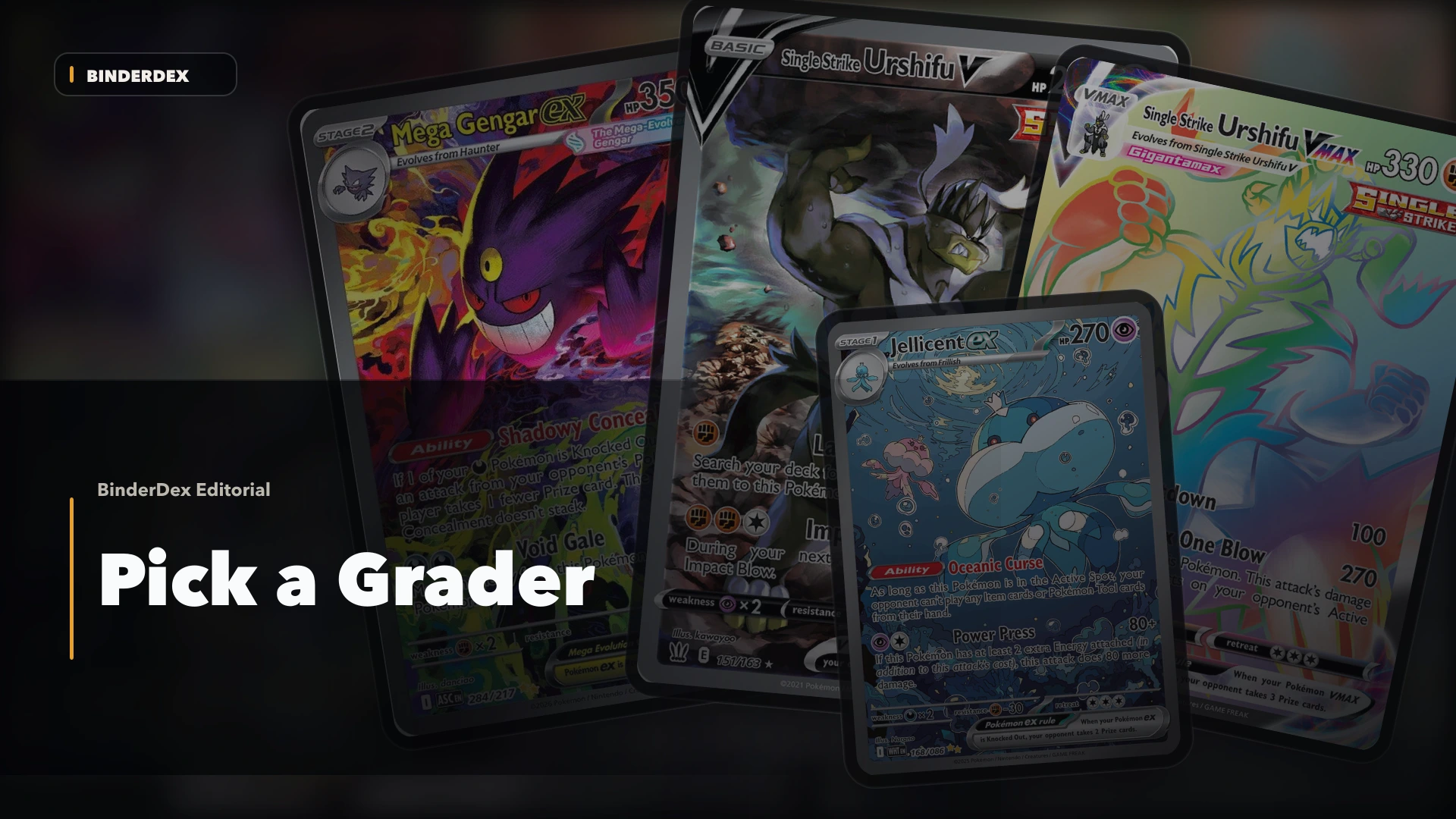
Buying, selling, shipping, grading, and platform guides for choosing the cleaner route before money changes hands.
The grading-company question gets noisy because every slab has a fan club. A better starting point is colder: what job does this specific card need the slab to do?
Company loyalty is not a submission plan. The card needs a purpose, a condition range, a cost route, and a downside before the label matters.
The Grader-Fit Read
PSA, CGC, BGS, and TAG each solve a different grading job. PSA is usually the first comparison when sale familiarity matters. CGC enters the conversation for TCG service fit and error-card routes. BGS makes sense when Beckett's grading style or label audience matters. TAG is strongest when the digital report, slab images, and presentation are part of the point.
The bigger collector issue is purpose. A grading company decision should start with why the card is being graded, not with a universal winner.
My read is that "which grading company is best?" is the wrong first question. Generic grading comparisons often collapse everything into resale context. That misses collector fit. A card may be graded for protection, display, authenticity, registry goals, sale context, personal preference, or error documentation. Those goals can point to different companies even when the card is the same.
The common mistake is choosing the grader before naming the job. A clean modern chase card that might be sold later, a weird error candidate, and a childhood favorite you just want protected should not be shoved through the same answer.
- PSA is usually the first comparison when broad market familiarity is part of the card's job.
- CGC is worth comparing for TCG service fit, error-card context, crossovers, and accepted-category questions.
- BGS belongs in the conversation when Beckett label preference or condition-scrutiny style matters to the collector or buyer.
- TAG fits collectors who care about modern presentation, images, and digital grading-report context.
- The card still needs identity, condition, value, cost, and official-rule checks before any submission route is strong.
- If the route depends on the best possible grade, the grader choice is probably premature.
- Purpose: Sell, display, protect, verify, registry, personal archive. A card graded for display may not need the same company fit as a card prepared for sale.
- Card type: Vintage, modern, error, autograph, high-end, sentimental. Company strengths and accepted categories should be checked before submission.
- Cost and timing: Service level, declared value, turnaround estimate. Fees and timing change. Use official pages before sending cards.
- Grade sensitivity: Centering, corners, edges, surface, print quality. If a card is condition-sensitive, the grader choice should reflect how much grade outcome matters.
Start with the card's job. Sale familiarity, error documentation, subgrade-style scrutiny, and personal display can point to different companies before the fee table even matters.
 PSAMarket-familiar sale, registry, and broad collector route.Broad familiarity does not remove condition risk.
 CGC CardsTCG, error-card, crossover, and grading-service route.Error and odd-card submissions still need current rules.
 BGSBeckett-brand and condition-scrutiny route.Use when the label and grading style fit the card's audience.
 TAGDigital grading report, slab imaging, and transparent-report route.Newer-company fit depends on buyer and collector audience.
The Bigger Collector Issue
The trap is treating grader choice as a brand ranking. A stronger question is: what outcome does this card need? Sale liquidity, authentication, presentation, accepted error labeling, turnaround, cost, and personal preference are different determinants.
The most expensive grading mistake is not choosing the second-best company. It is grading a card for a purpose you did not actually have.
That is why the first cut should be blunt: if the card's purpose is "maybe it goes up," no company has solved the problem yet.
The Route-First Comparison
| Company | Best fit | Official page to check | Collector caveat |
|---|---|---|---|
| PSA | Broad market familiarity, registry goals, and common buyer recognition. | Trading-card grading service, pricing, declared value, turnaround estimates, population report. | Familiarity does not make the card grade higher. Centering, surface, corners, and eye appeal still decide the outcome. |
| CGC Cards | TCG grading, error-card context, crossover routes, and accepted-category checks. | Services and fees, cards accepted, error guide, grading scale. | CGC lists an error add-on, but a card still needs category evidence and submission fit. |
| BGS | Beckett-label preference, condition-scrutiny route, and collectors who care about the BGS slab context. | Beckett grading and current pricing or turnaround pages. | The card needs an audience that values the label; otherwise the route can become personal preference only. |
| TAG | Digital Imaging and Grading reports, slab imaging, 1000-point score context, and modern presentation. | TAG service-tier and pricing pages. | TAG's report can be useful, but the audience may be narrower than PSA's for some sale routes. |
Sale familiarityPSAStart here when broad buyer recognition, registry context, and familiar slab language are part of the card's job.Still inspect centering, surface, corners, and grade range before submitting.Error candidateCGC CardsCompare CGC when the card is an error candidate, odd category, crossover candidate, or TCG-fit submission.Name the error route before paying for a submission.Subgrade contextBGSCompare Beckett when subgrade-style condition scrutiny, half-point context, or the Beckett slab is the point.The label preference should match the expected audience for that exact card.Digital reportTAGCompare TAG when raw images, slab imaging, QR-accessible DIG reports, and modern presentation are part of the desired outcome.The report is useful only if the collector or buyer cares about that transparency.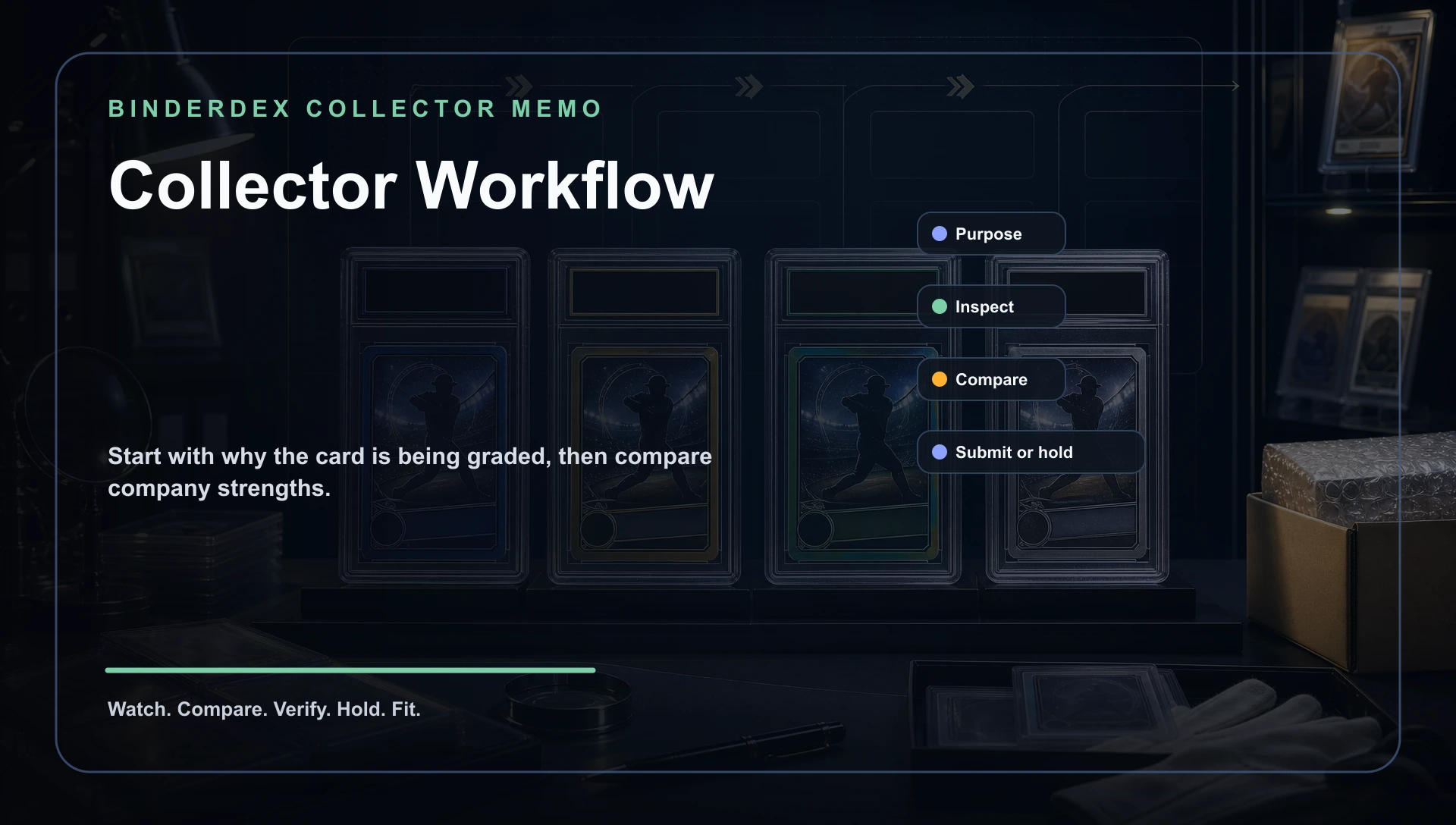
Company-By-Company Route Notes
PSAPSA is the familiarity route, not a grade guarantee.
Use PSA when broad market familiarity is part of the card's job, then check current tiers, declared value, turnaround estimates, and population context.
PSA says authentication verifies originality and grading assesses quality and condition on its 10-point scale. Its grading-standards page also makes the condition problem explicit: a PSA 10 requires sharp corners, sharp focus, original gloss, no staining, and tight centering tolerance.
That means the PSA route should start with condition honesty. If the card has surface lines, weak centering, corner pressure, or a print issue that matters to eye appeal, market familiarity will not rescue the grade.
CGC CardsCGC is the taxonomy-and-service-fit route.
Use CGC when TCG category fit, error-card handling, crossover routes, or CGC label preference matters.
CGC's services page is useful because it makes the service decision concrete: current tiers, turnaround estimates, crossover rules, and an error add-on for cards with printing errors. Its error guide is also useful when a card needs category language before submission.
An error-card checkbox is not evidence. The card still needs exact identity, a named category, photos, and a damage screen before the submission route makes sense.
BGSBGS is the label-preference and scrutiny route.
Use BGS when the Beckett slab, brand context, or condition-scrutiny style fits the collector's reason for grading.
BGS can make sense when the collector specifically wants Beckett context. Beckett's public grading material emphasizes the four condition categories collectors already argue about: centering, corners, edges, and surface. It also describes half-point grading increments and the report-card/subgrade style that many collectors associate with BGS.
Audience fit is the hard question. If the card is being graded for a later sale, ask whether likely buyers for that exact card prefer BGS, PSA, CGC, TAG, or raw. The answer can change by card type.
TAGTAG is the report-and-presentation route.
Use TAG when the report, images, modern slab presentation, and transparent grading record are part of the desired outcome.
TAG's help page says its available services include raw card images, slab imaging, UV protection, QR-accessible DIG reports, and service tiers with TAG Score options on some tiers.
That is useful when the collector wants documentation, presentation, and a digital report. Audience still matters. A transparent report can matter a lot to one buyer and less to another.
A Better Workflow
1. Start with the reason for grading
Before comparing companies, write down the reason the card is being graded. Sale familiarity often puts PSA on the first line of the comparison. Error-card context brings CGC accepted-card guidance into view. Subgrade-style scrutiny or Beckett brand preference can make BGS relevant. Digital reporting and slab presentation can make TAG worth checking. The purpose narrows the field.
Write the reason down before you compare companies. If the reason sounds vague, the card may not be ready for submission.
Example: say you own a clean Mega Gengar ex and your note says "possible sale with PSA 10 upside." In BinderDex, open the exact card, check raw value, add a note about centering and surface, then compare PSA 10 and PSA 9 context. A workable PSA 9 downside makes the PSA route stronger. A strange print anomaly brings CGC into the conversation after the anomaly is documented. A display-only route with interest in the report can make TAG a better fit.
2. Check accepted-card and service rules
Do not assume every company will handle every card type in the way you expect. Check official service pages, accepted-card guidance, pricing, declared value rules, and turnaround estimates before submission. A grading plan based on old pricing or unsupported assumptions can turn a reasonable card into a frustrating project.
Official rules are not paperwork after the decision. They are part of the decision, especially for odd cards, declared values, service levels, and changing turnaround expectations.
3. Separate card condition from company preference
A company cannot turn a weak-condition card into a strong one. Inspect centering, corners, edges, surface, dents, print lines, and holo scratching before deciding. If the grade range is likely to be lower than the collector needs, the best company may be no company. Holding raw can be the calmer fit.
Condition is the veto. A card that cannot plausibly reach the outcome you need should go back through how to grade Pokemon cards and what collectors should check first before the company comparison continues.
4. Use BinderDex to compare outcomes before submitting
Put the card into BinderDex with notes about purpose, condition confidence, and target company. Then compare possible routes: keep raw, submit to one company, wait for service changes, or sell/trade raw. The grading decision becomes a documented collector choice instead of a reflex.
A documented route prevents reflex grading. The choices should remain visible: grade now, wait, keep raw, sell raw, or move the card into a different collection role.
Five Card Cases
These examples use BinderDex production RDS evidence queried on June 4, 2026. TCGplayer condition rows listed here were updated in BinderDex on May 18, 2026. The rows are route evidence, not submission advice by themselves.
| Card case | Rows checked | Stronger grader route | Veto before submitting |
|---|---|---|---|
| Mega Gengar ex, Ascended Heroes, 284/217, sale-minded modern chase | Collectr NM holo $1,360.59; TCGplayer NM holo $1,316.45 | PSA belongs in the first comparison because buyer familiarity matters if the card is sale-minded. | If the lower-grade route is not acceptable, the submission depends too heavily on a perfect result. |
| Pikachu ex, Ascended Heroes, 276/217, high-end raw candidate | TCGplayer NM $1,224.19; LP $856.97 | PSA can make sense only after centering, back whitening, and surface checks support the upside. | A Lightly Played copy should not be submitted under clean-card math. |
| Umbreon VMAX Alt Art Secret, Evolving Skies, 215/203 | Collectr NM holo $2,103.75; +$39.50 7d; -$14.96 30d | PSA can fit resale familiarity; TAG can fit display/report goals if the owner values the documentation. | Short-window movement does not replace surface, centering, and one-grade-downside checks. |
| Infernape Lv.X, Diamond and Pearl Promos, DP10, older promo | TCGplayer NM $77.82; LP $39.51; MP $20.30; HP $10.84; Damaged $8.82 | The company choice comes after condition. PSA/CGC/BGS/TAG is premature until the card passes the back and surface screen. | A played copy can be collectible raw, but the grading case is fragile if the clean lane is gone. |
| Skarmory, Expedition, 27, Holofoil, older holo | TCGplayer NM $76.00; LP $62.36; MP $39.52; HP $33.11; Damaged $23.53 | PSA is the market-familiar route; BGS can be a label-preference route; TAG can be display/report route. | Confirm holofoil versus reverse holofoil first. Finish mismatch breaks every grade comparison. |
Rayquaza Gold Star from EX Deoxys is the source-caution version of this same problem: the June 4 BinderDex snapshot showed Collectr NM holo at $7,173.33 and TCGplayer NM normal at $2,500.99. Do not turn that into a clean price spread without checking variant, finish, source, and sold context.
The lesson is not that one company wins all five cases. The lesson is that the same card can point to different companies when the job changes. Sale familiarity, error documentation, label preference, digital reporting, and sentimental display are different routes.
Submission Proof Standard
Before paying for grading, the submission should have a short written case.
That case should name the exact card, the purpose of grading, the expected grade range, the downside route if the card misses, the company being considered, and the official page that supports the service choice.
The most useful sentence is often the veto: "I will not submit this if the PSA 9 route is weak," "I will not submit this error candidate until I can name the category," or "I will keep this raw because the slab does not improve the card's job." A grading plan is strongest when the collector can explain what would make them stop.
Keep that proof note with the card until the order returns. It gives you a way to judge the result without rewriting history around the grade that arrived.
Tradeoffs Before You Act
Grading adds cost, time, and grade uncertainty. That can be worth it when the card has a clear job. It is wasteful when the slab is only a reflex.
| Action | Best when | Check first | Watch out for |
|---|---|---|---|
| PSA | Market familiarity and broad buyer recognition are central to the card's purpose. | Current PSA pricing, service level, declared value rules, and population context. | Popularity does not remove condition risk or turnaround uncertainty. |
| CGC | The card fits CGC's accepted categories, error-card context, or collector preference. | Current CGC services, fees, and accepted-card guidance. | Do not assume every anomaly will receive the label you want. |
| BGS | The collector values BGS brand fit, grading style, or subgrade-era context. | Current Beckett pricing, turnaround, and service details. | The label preference must justify the route for this specific card. |
| TAG | Transparent digital grading, slab presentation, and modern workflow fit the collector goal. | Current TAG service availability and accepted submission rules. | Newer-company fit depends on the buyer and collector audience. |
A useful decision matrix should expose the veto. PSA can be familiar and still wrong for a low-confidence card. CGC can be appropriate for an error candidate and still premature without category evidence. BGS can be attractive only when the audience values that slab. TAG can be excellent for documentation and still narrower for resale.
My decision rule is this: choose the grading company only after the card's purpose is named. A sale card, display card, error candidate, registry target, and personal archive card can point to different answers. If you cannot explain why that company fits that card, the submission is probably still premature.
What would change the answer is a change in purpose or rules. A card meant for personal display can become a sale candidate. An error card can run into accepted-category limits. A service tier can change cost or timing. The grader choice should update when those determinants update. If the route changes, the best company may change with it. Treat that flexibility as discipline, not indecision. The slab should serve the card's job.
How BinderDex Fits
BinderDex should keep the grading reason attached to the exact card. That means card identity, raw market context, grade target, condition notes, and the route if the card misses.
For Mega Gengar ex, the BinderDex note might say: "consider PSA only if centering and surface make PSA 10 plausible; compare PSA 9 downside first." For a possible error card, the note should name the anomaly and say what evidence is still missing.
Use BinderDex as the operating layer, then use official grading pages for the submission rules that matter before money, cards, or time move.
If the decision is between possible grades, use PSA 10 vs PSA 9 as the next comparison layer after the company route is chosen.
If the decision is still about cost, use how much it costs to grade a Pokemon card before picking a tier. If value is still uncertain, use how to check Pokemon card value before comparing graded outcomes. If the card may be an error, use how to identify misprint Pokemon cards without confusing damage before submitting it under the wrong story.
The clean route: choose the grader after the card's job is named, the official rules fit, and the one-grade-lower outcome does not wreck the decision.
FAQ
Which grading company is best for Pokemon cards?
There is no universal best company for every card. PSA, CGC, BGS, and TAG fit different collector jobs, so the decision should start with purpose, condition confidence, value context, cost, and official service rules.
When should I choose PSA?
PSA is often the first comparison when broad buyer recognition, registry context, population reports, and familiar slab language matter. Condition still controls the outcome, so PSA familiarity does not make a weak card grade stronger.
When should I choose CGC?
CGC is worth comparing when the card fits its TCG services, crossover route, accepted categories, or error-card workflow. An error candidate still needs photos, a named anomaly, and damage ruled out before submission.
When do BGS or TAG make sense?
BGS can make sense when Beckett label preference, half-point context, or condition-scrutiny style matters to the card's audience. TAG can make sense when report transparency, images, and modern presentation are part of the collector goal.
Should I pick the cheapest grading company?
The cheapest route is not automatically the best route. Compare landed cost, turnaround, accepted-card rules, likely grade range, and the reason the slab helps. A low fee can still be wasteful when the card's purpose is weak.
What To Watch Next
- Official fees: Check PSA, CGC, BGS, and TAG pages before submission. Risk: Costs, tiers, and turnaround estimates can change.
- Population context: Use population reports where available to understand graded supply. Risk: A high grade can still be common.
- Accepted categories: Verify errors, odd cards, and special cases directly with the company. Risk: A desired label may not be available.
- Raw alternative: Keep raw if the card's role is binder fit, not slab fit. Risk: Grading can add cost without improving the collector decision.
Keep watchlist moves separate from your binder.
Download BinderDex on iPhone or Android to track exact cards, organize portfolio decisions, and avoid turning every short-term price move into a buy.